Region: Australia
Being Me Being You: How I need you to be, to be with me.

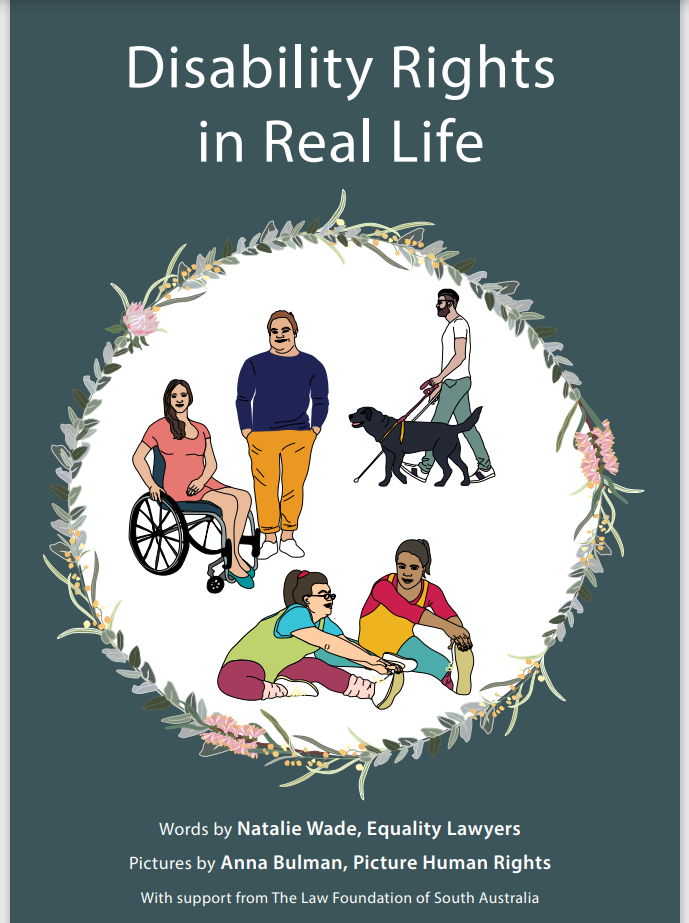
Disability Rights in Real Life
My Decision Making Toolkit
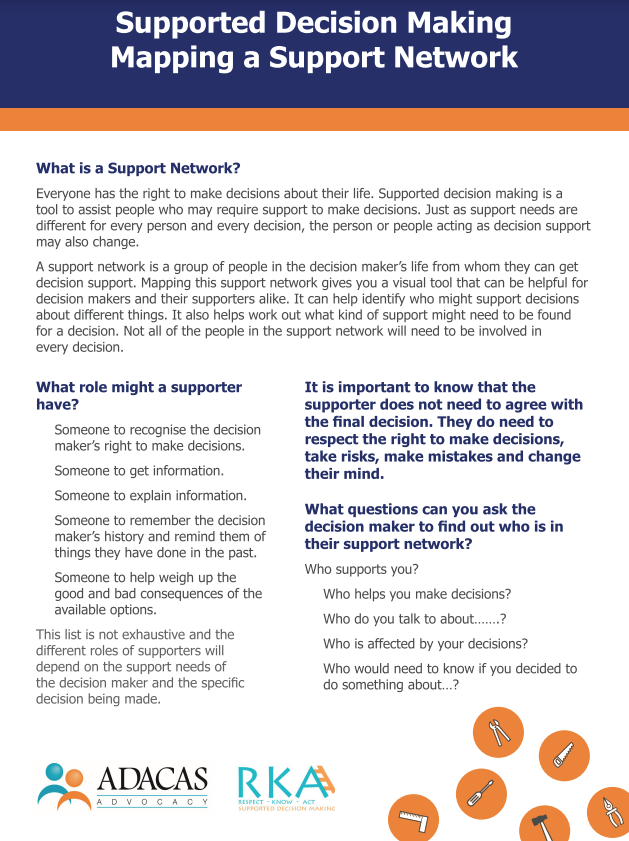
Supported Decision Making: Mapping a Support Network
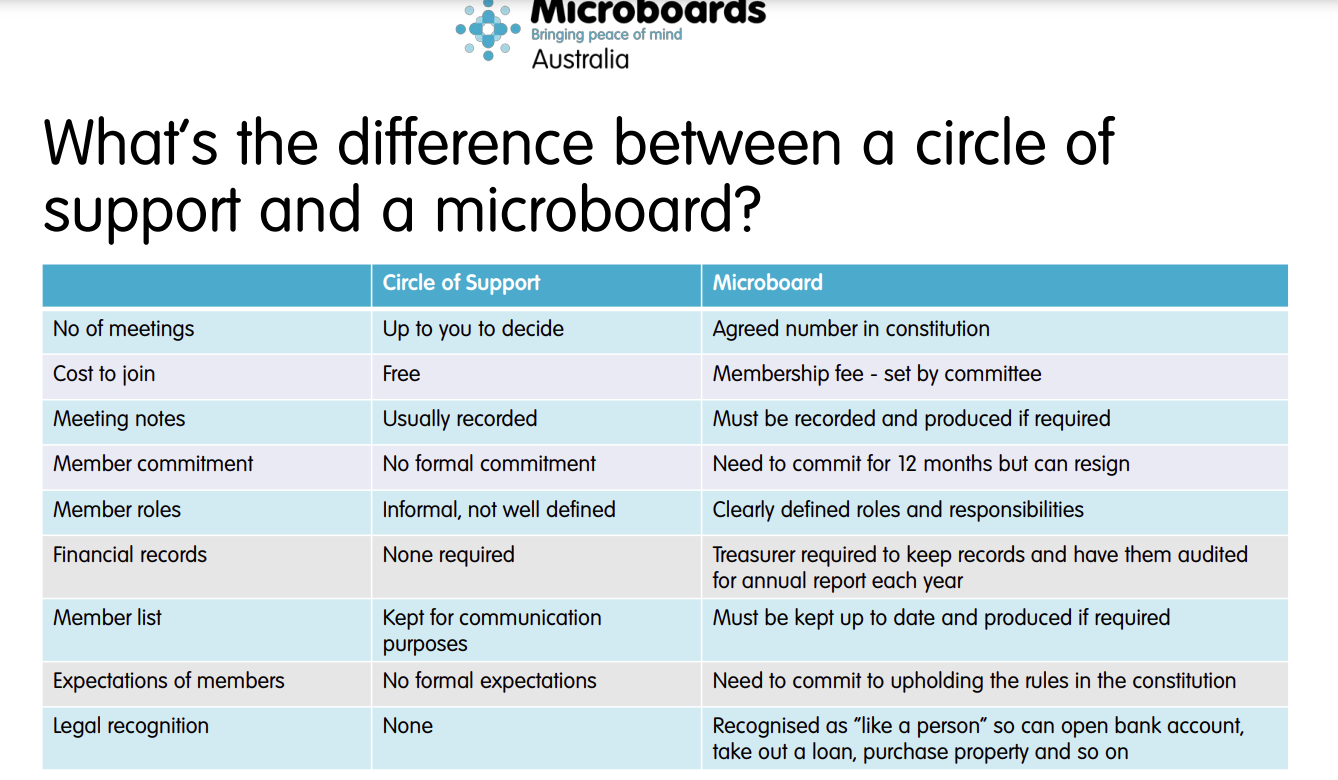
Microboards and Circles of Support: What’s the Difference?
Support for Decision Making in the NDIS
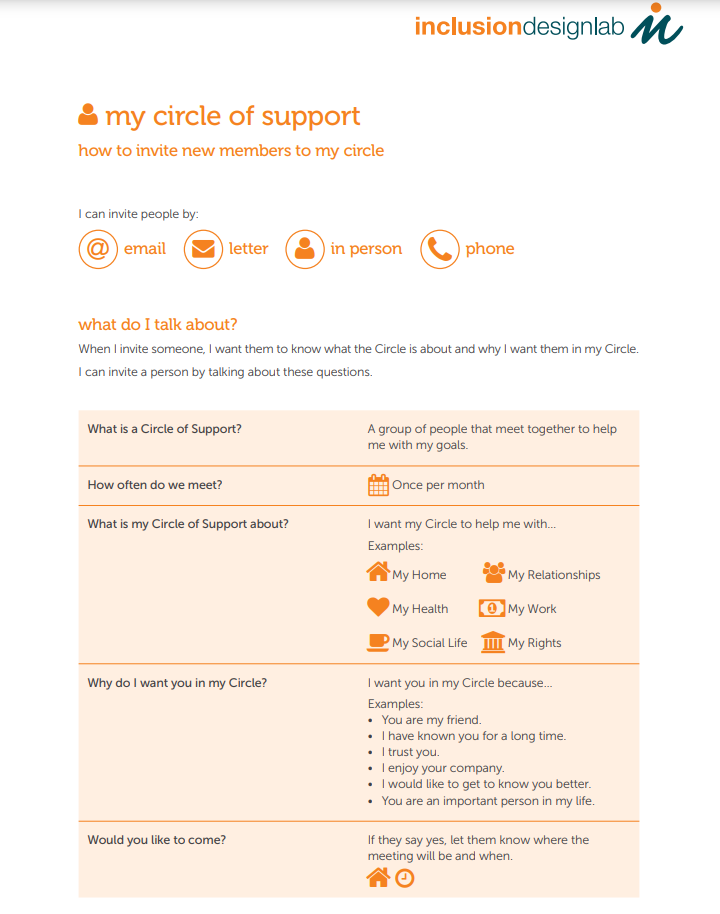
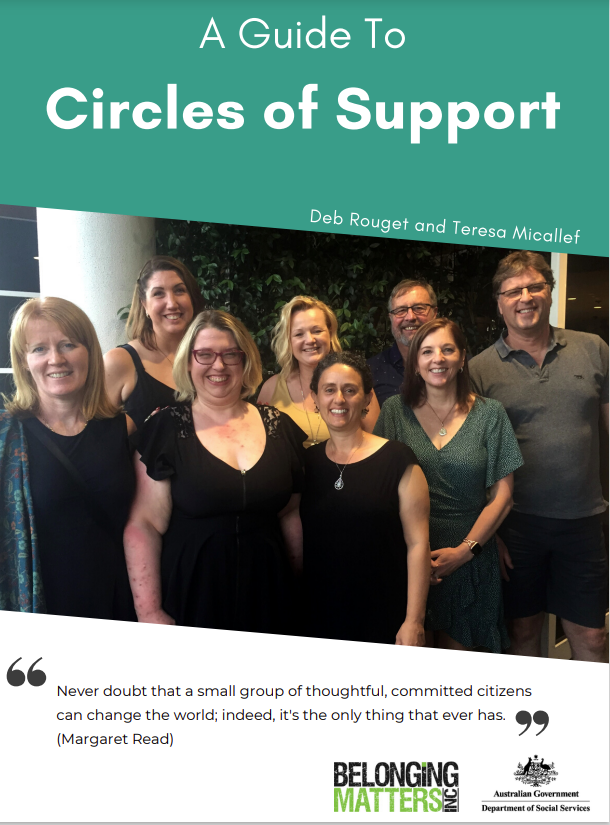
A Guide to Circles of Support
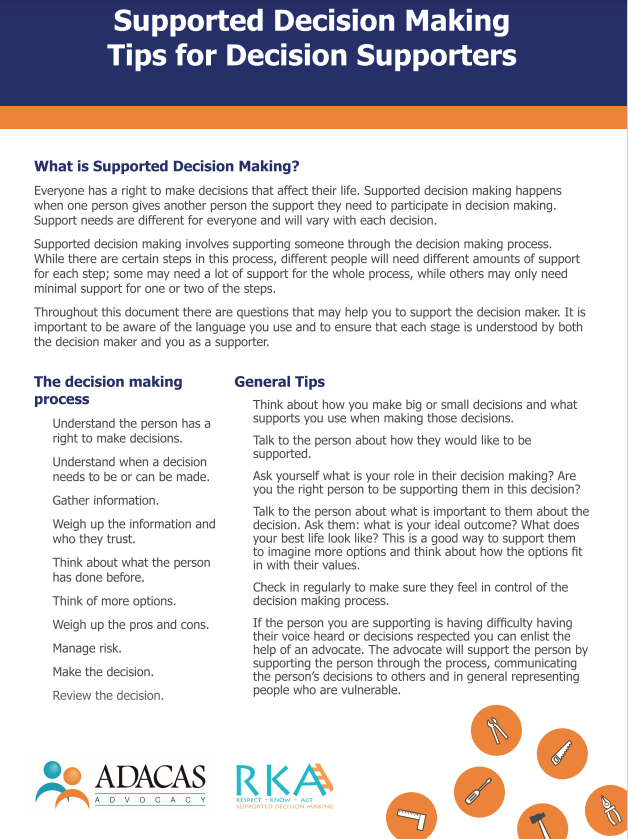
Supported Decision Making: Tips for Decision Supporters
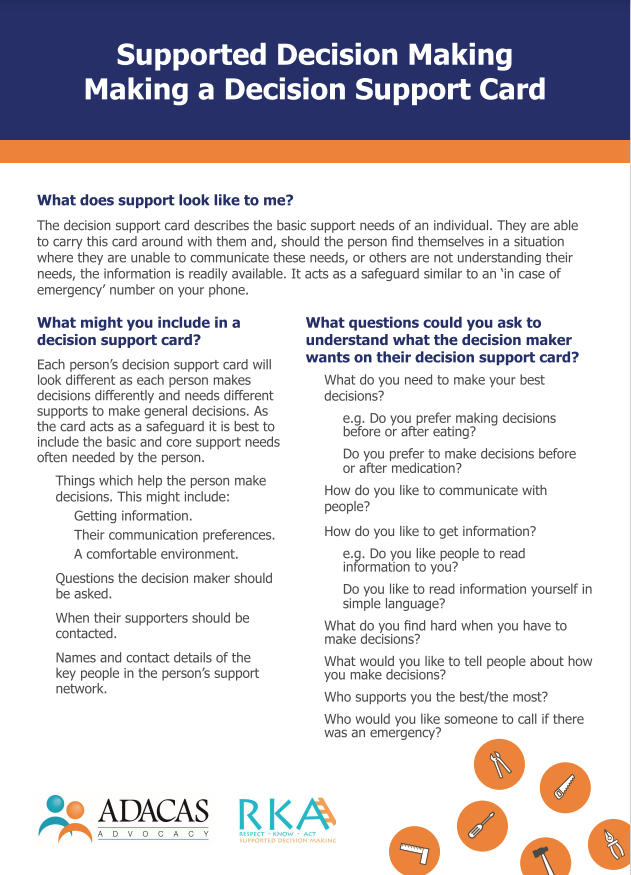
Supported Decision Making: Making a Decision Support Card
The Good Life – Family and Friends
Realising ‘will, preferences and rights’: reconciling differences on best practice support for decision-making?
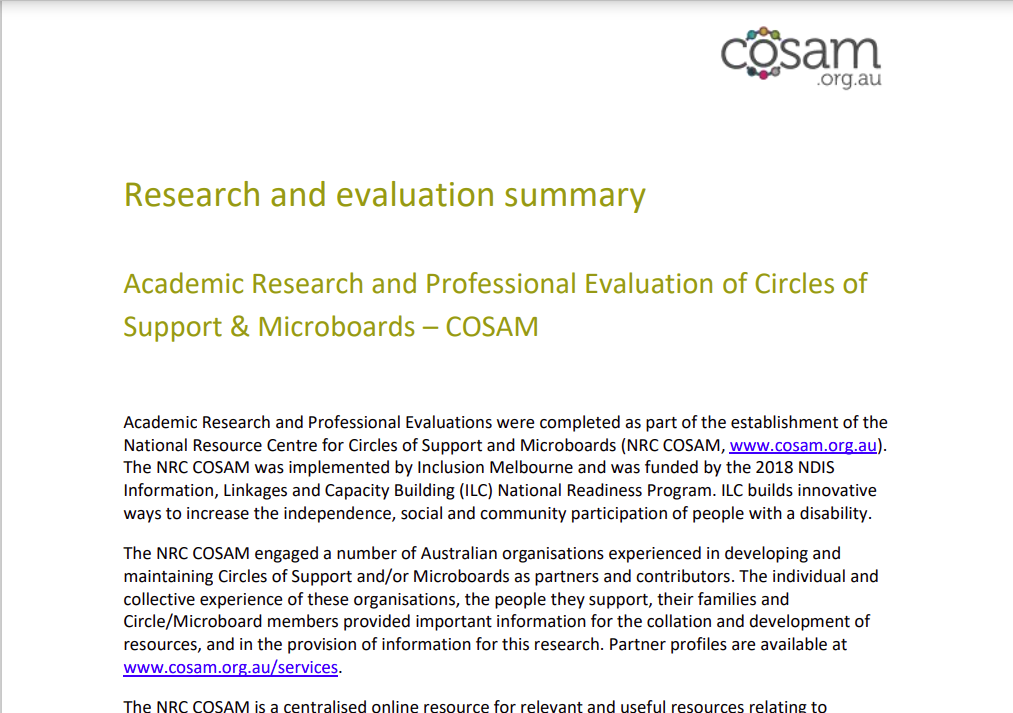
Academic Research and Professional Evaluation of Circles of Support & Microboards – COSAM
The temporalities of supported decision-making by people with cognitive disability
It’s My Choice! The Principles of Choice
It’s My Choice! A Guide for People with a Disability, their Family Carers, Friends and Advocates
It’s My Choice! A Guide for Disability Support Providers
It’s My Choice! Film and Discussion Guide
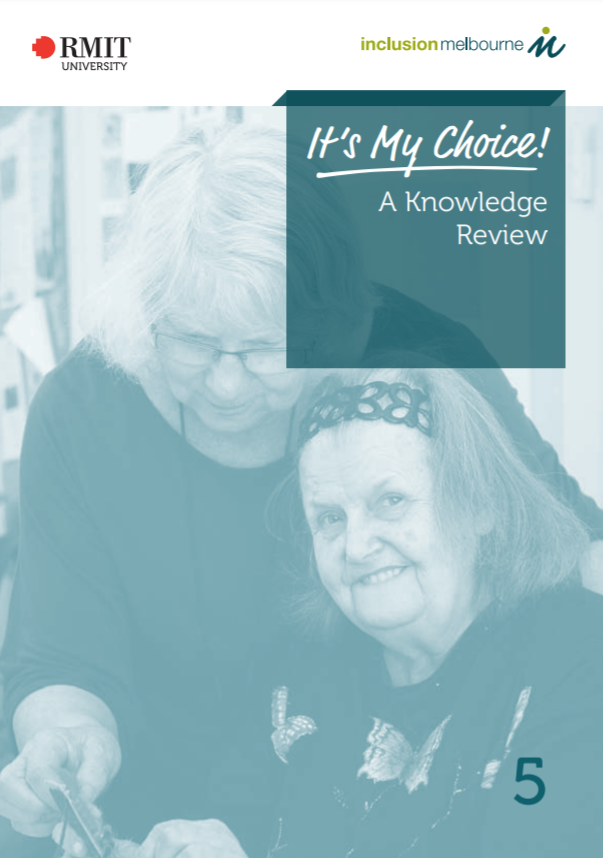
It’s My Choice! A Knowledge Review
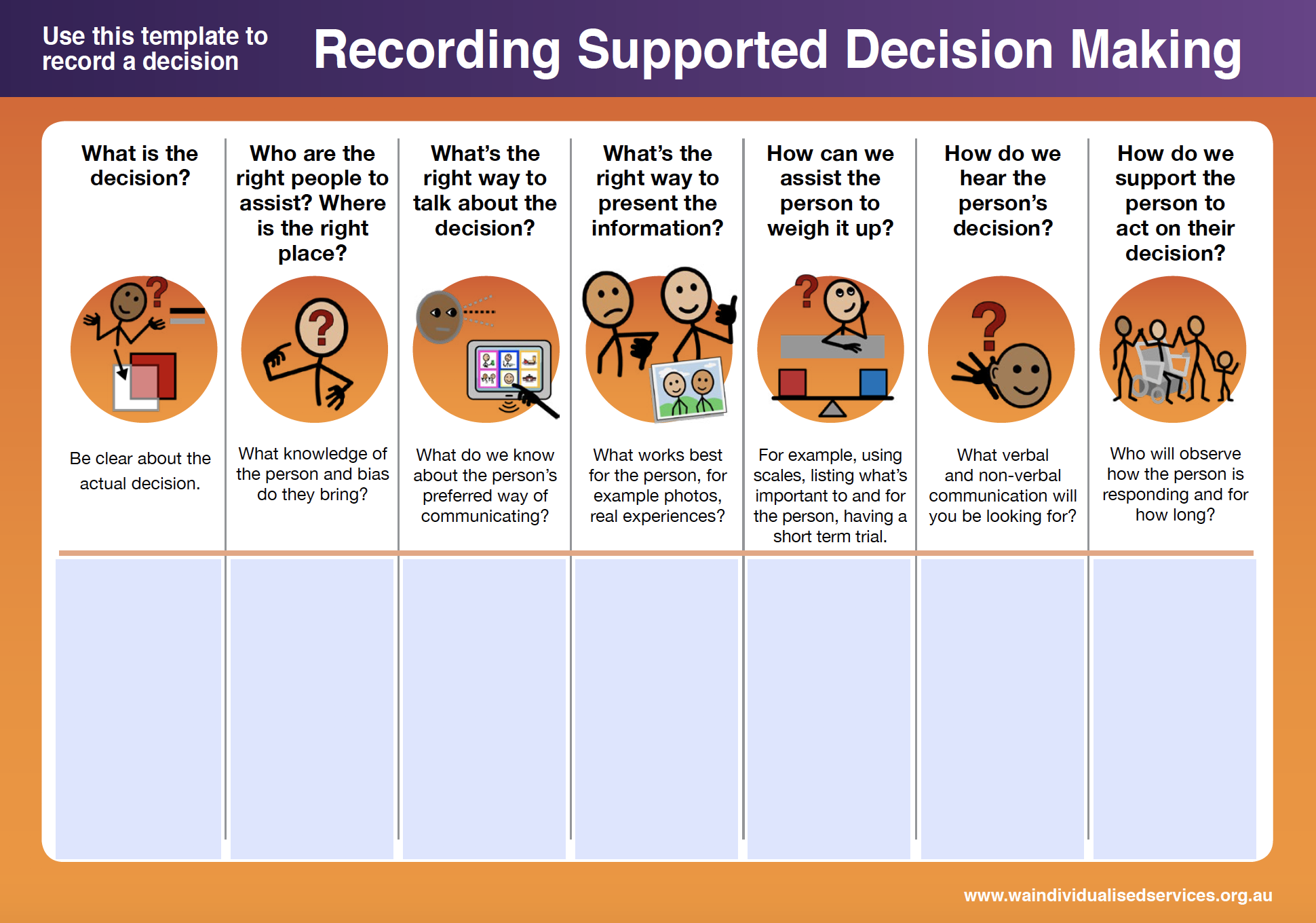
Template for Recording Supported Decision Making
Understanding a Person’s Communication
Communication Passport Profile
Good Assistance
Some tips on how to provide good assistance when supporting a person with decision making.
Supporting Decisions
Getting to Know The Person
This video highlights the importance of really getting to know a person for successful supported decision making.
Peer Network Meeting Topic: Talking About Supported Decision Making
The La Trobe Support for Decision Making Practice Framework Activity Booklet
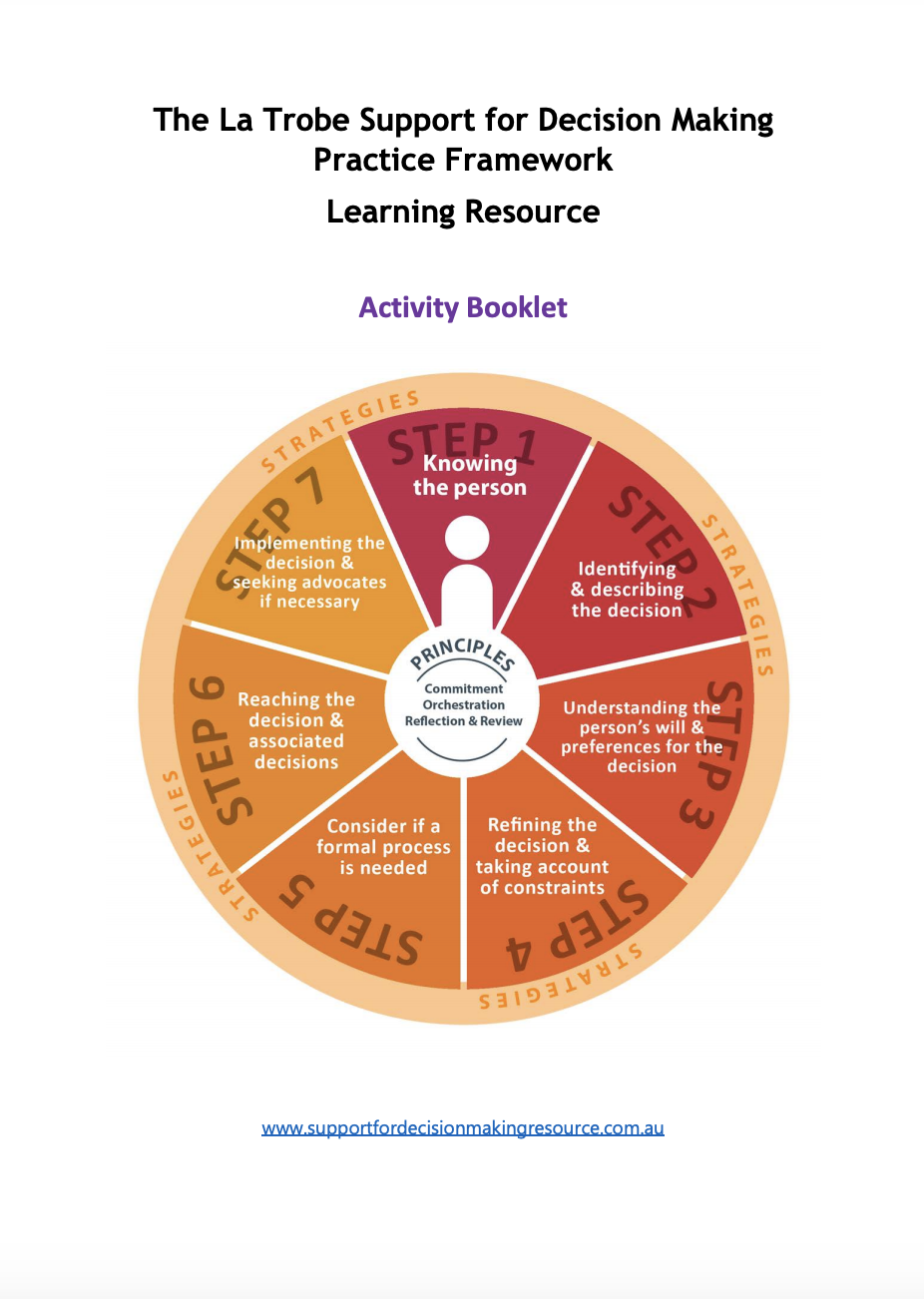
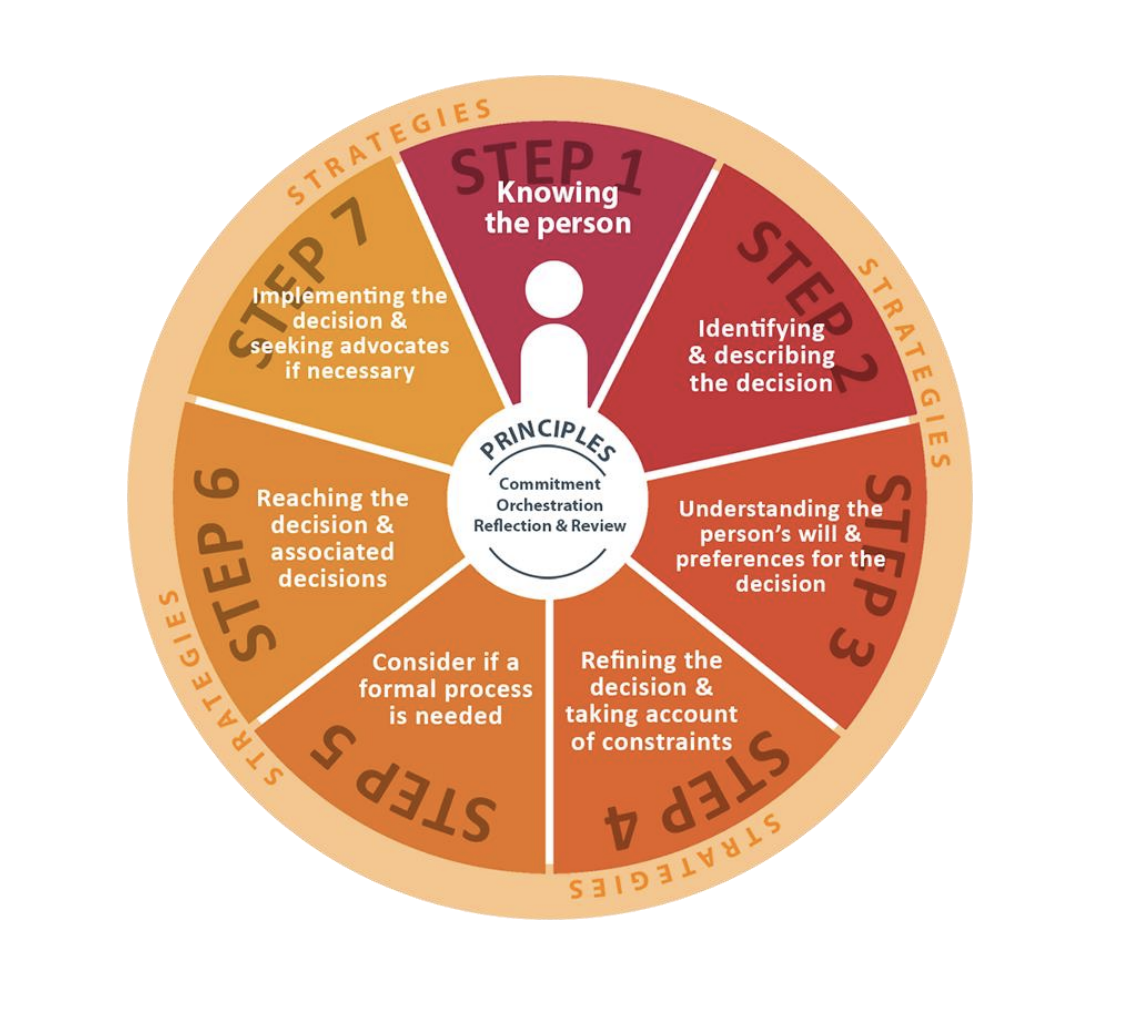
The La Trobe Support for Decision Making Practice Framework
Decision Recording Template
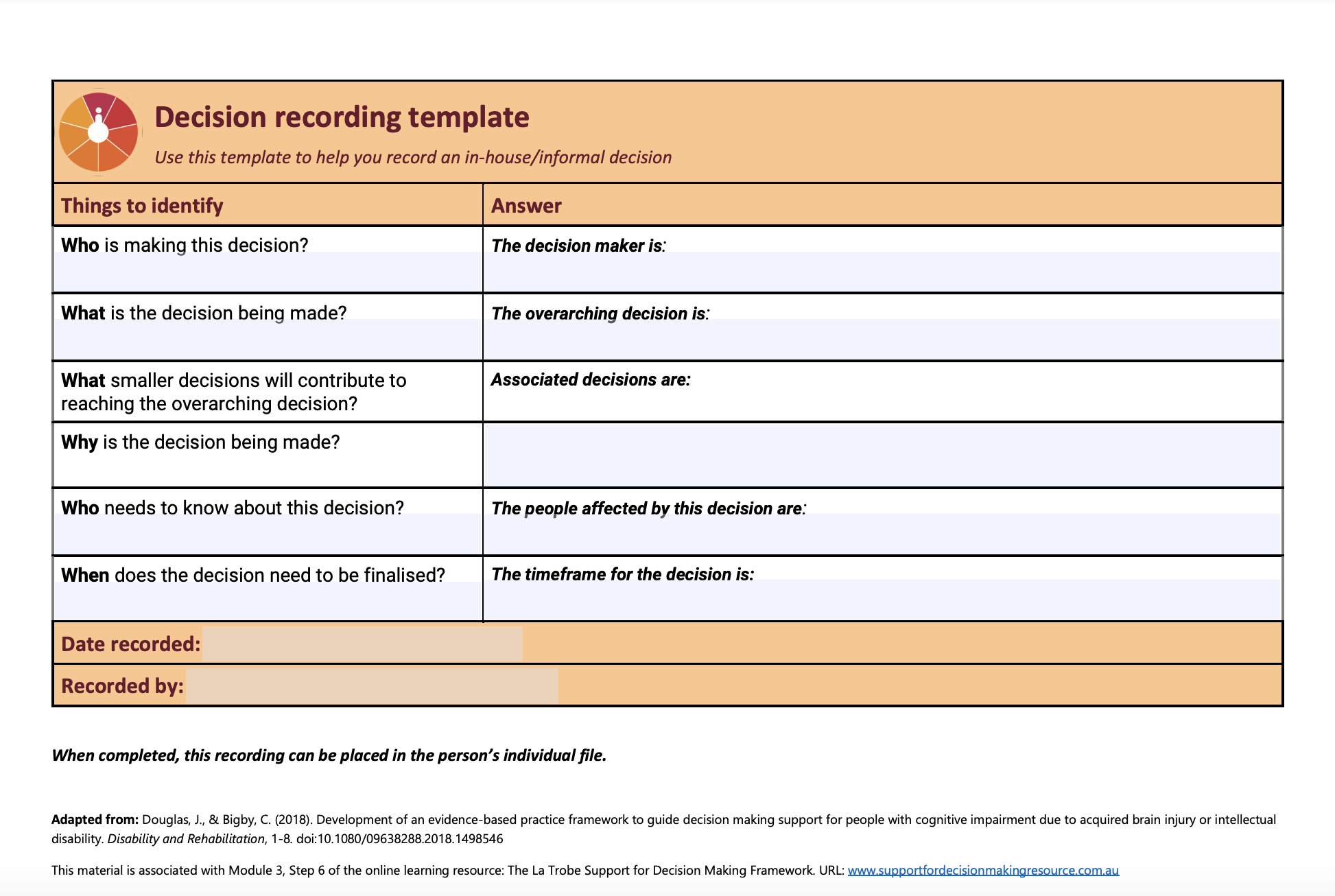
A fillable document to record a decision being made with support.
Support for Decision Making Checklist
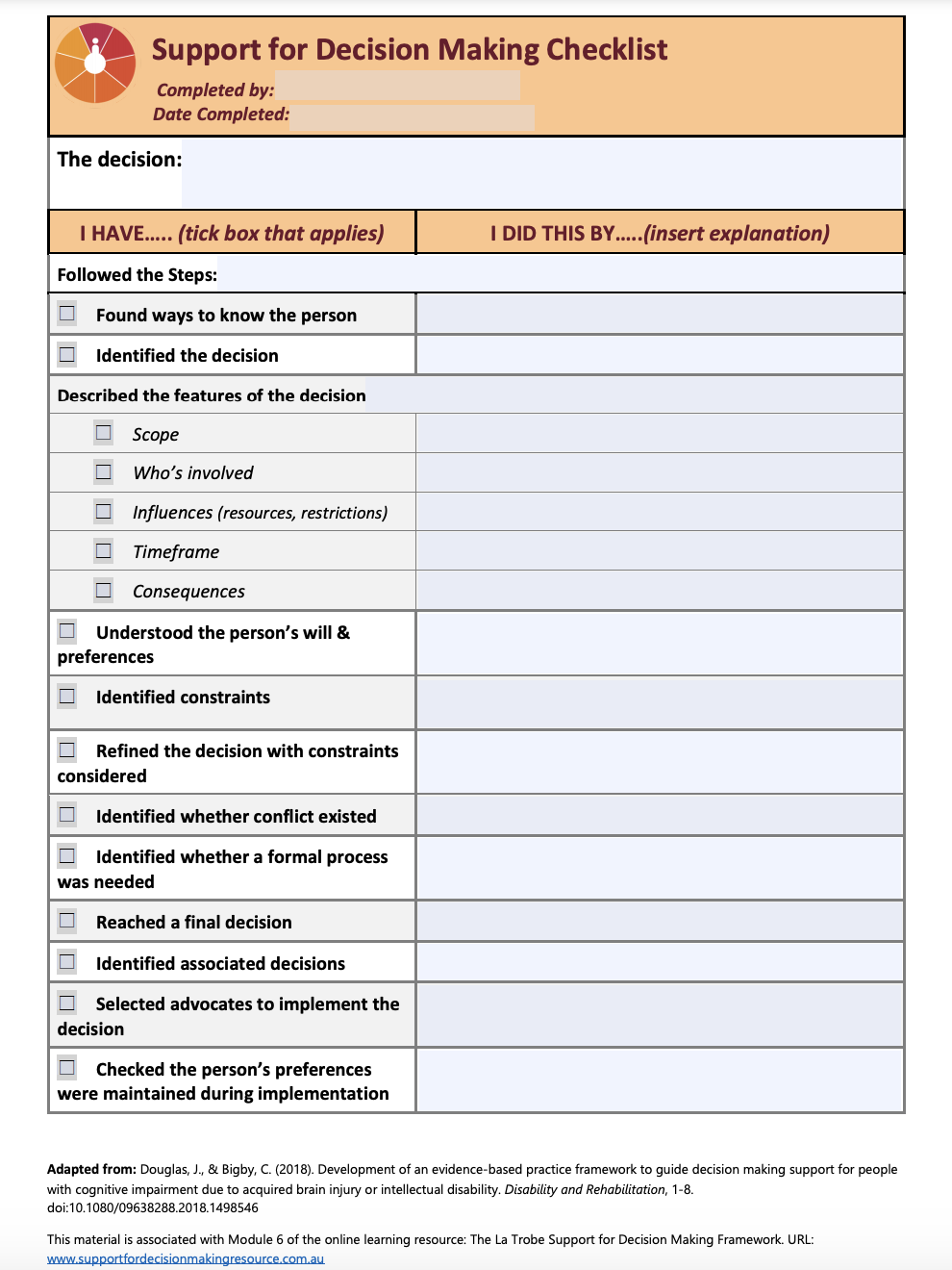
A fillable checklist to go alone with The La Trobe Support for Decision Making Practice Framework.
The La Trobe Support for Decision Making Practice Framework Workbook
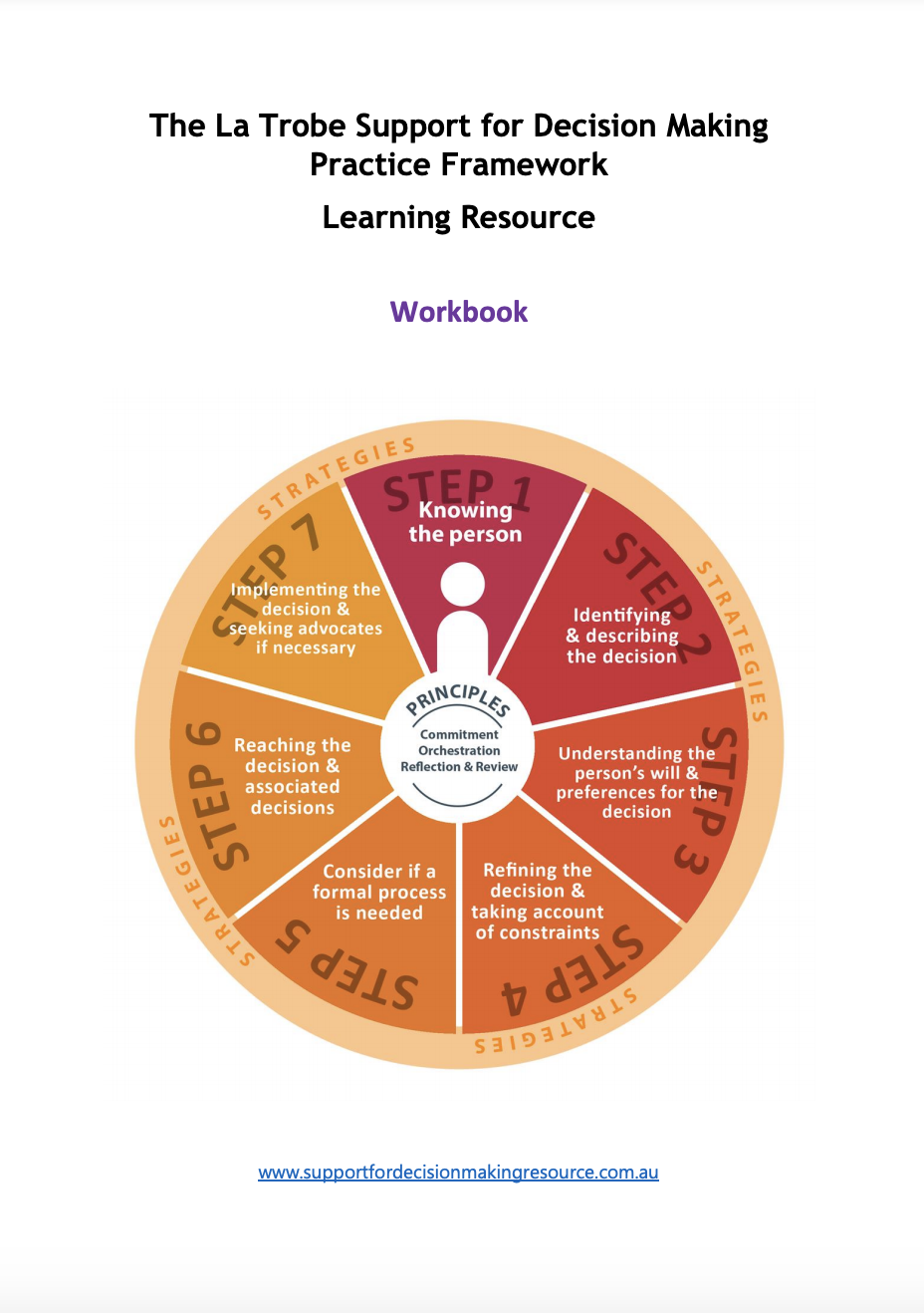
This online learning resource is about support for decision making. It will present the first evidence-based framework to guide you through the process of supporting people with cognitive disabilities to make decisions. Using this framework will help you to enable the people you support to exercise choice and control in their own lives.
The La Trobe Support for Decision Making Practice Framework Learning Resource
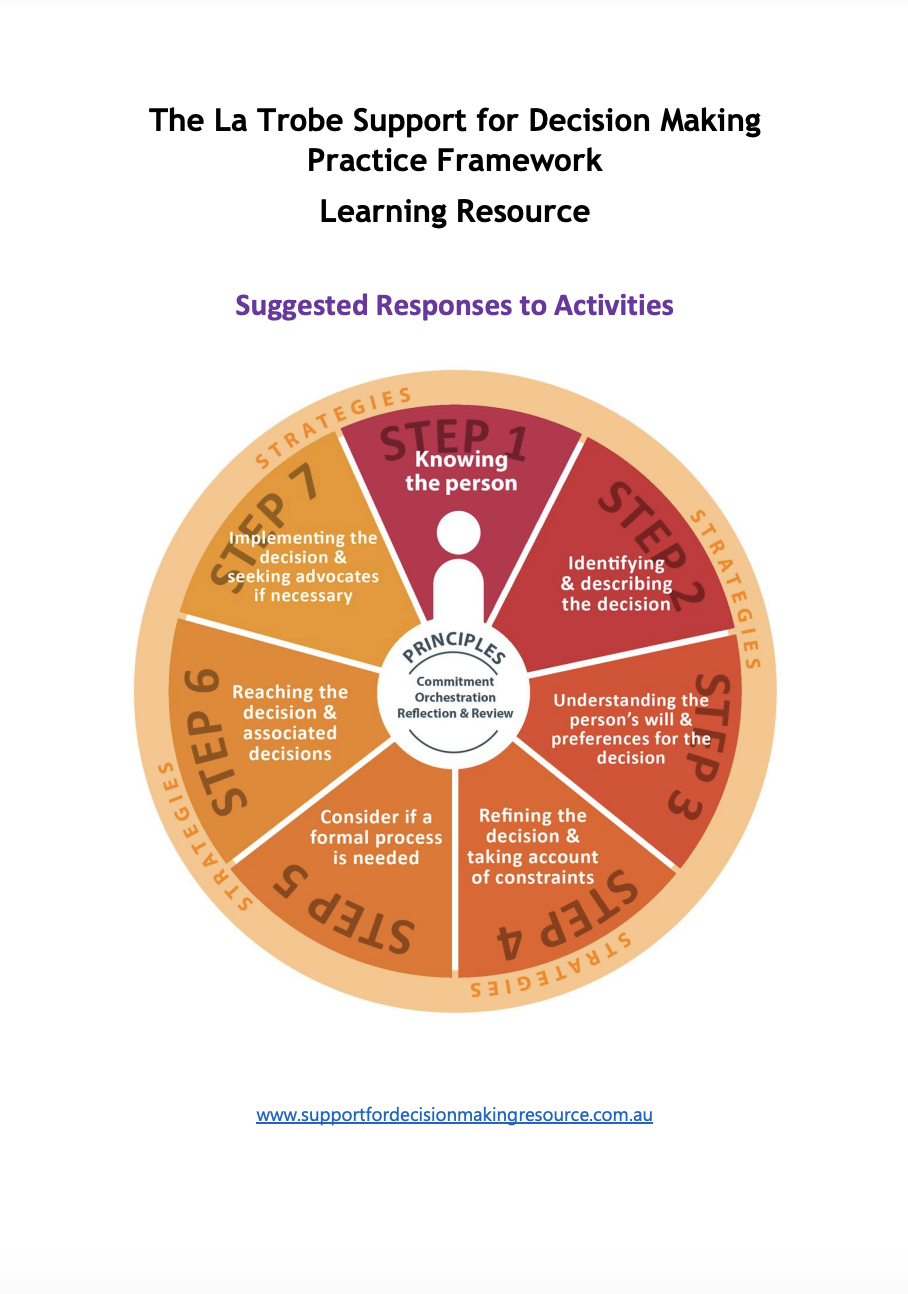
This online learning resource is about support for decision making. It will present the first evidence-based framework to guide you through the process of supporting people with cognitive disabilities to make decisions. Using this framework will help you to enable the people you support to exercise choice and control in their own lives.
Reflecting on Your Role as a Decision Supporter
A presentation by Michelle Browning on how Decision Supporters can offer the best possible support to Decision Makers.
Michelle Browning Presentation for Decision Makers

A presentation by Michelle Browning for Decision Makers about Supported Decision Making.
Promoting Rights and Interests: Supported Decision Making Annual Report
This report will reconsider the Stepped Model of Supported and Substitute Decision Making, the supported decision-making approach used in the South Australian Project, and the results of that project. This summary in this year’s Annual Report seeks to bring together this information.
Evaluation of Supported Decision Making Project in SA
This evaluation report is in several parts. It provides background to the project. It includes a section on findings from the evaluation, with particular attention given to the experience of the project participants and their supporters. The report includes four stories from people with disabilities who were participants in the project. It also includes a section on issues to consider in the further development of Supported Decision Making in South Australia.
Providing support for decision making: Perspectives of family members and workers in disability support services
Supporting decision making: A guide to supporting people with a disability to make their own decisions
Disability Services Supporting decision making: A quick reference guide for disability support workers
Supported decision-making and its importance in the context of the NDIS
Developing a Safeguards Framework for People Supported by the NDIS
Feedback on the NDIS Nominee Rules: Recognising supported decision making in nominee arrangements
Making Decision-Making a Part of Life
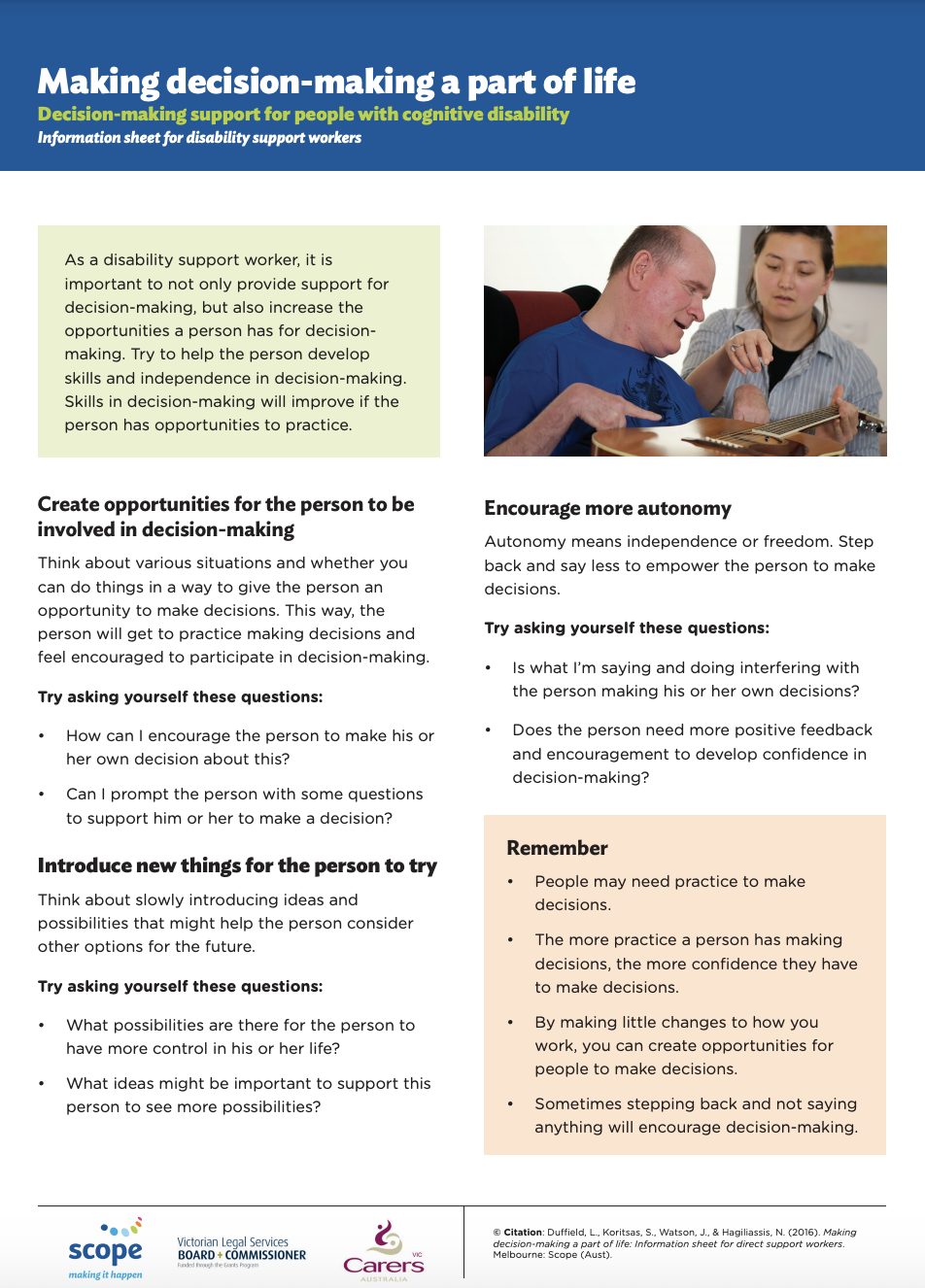
As a disability support worker, it is important to not only provide support for decision-making, but also increase the opportunities a person has for decision making. Try to help the person develop skills and independence in decision-making. Skills in decision-making will improve if the person has opportunities to practice. This factshett is designed for support workers supporting people with decision making.
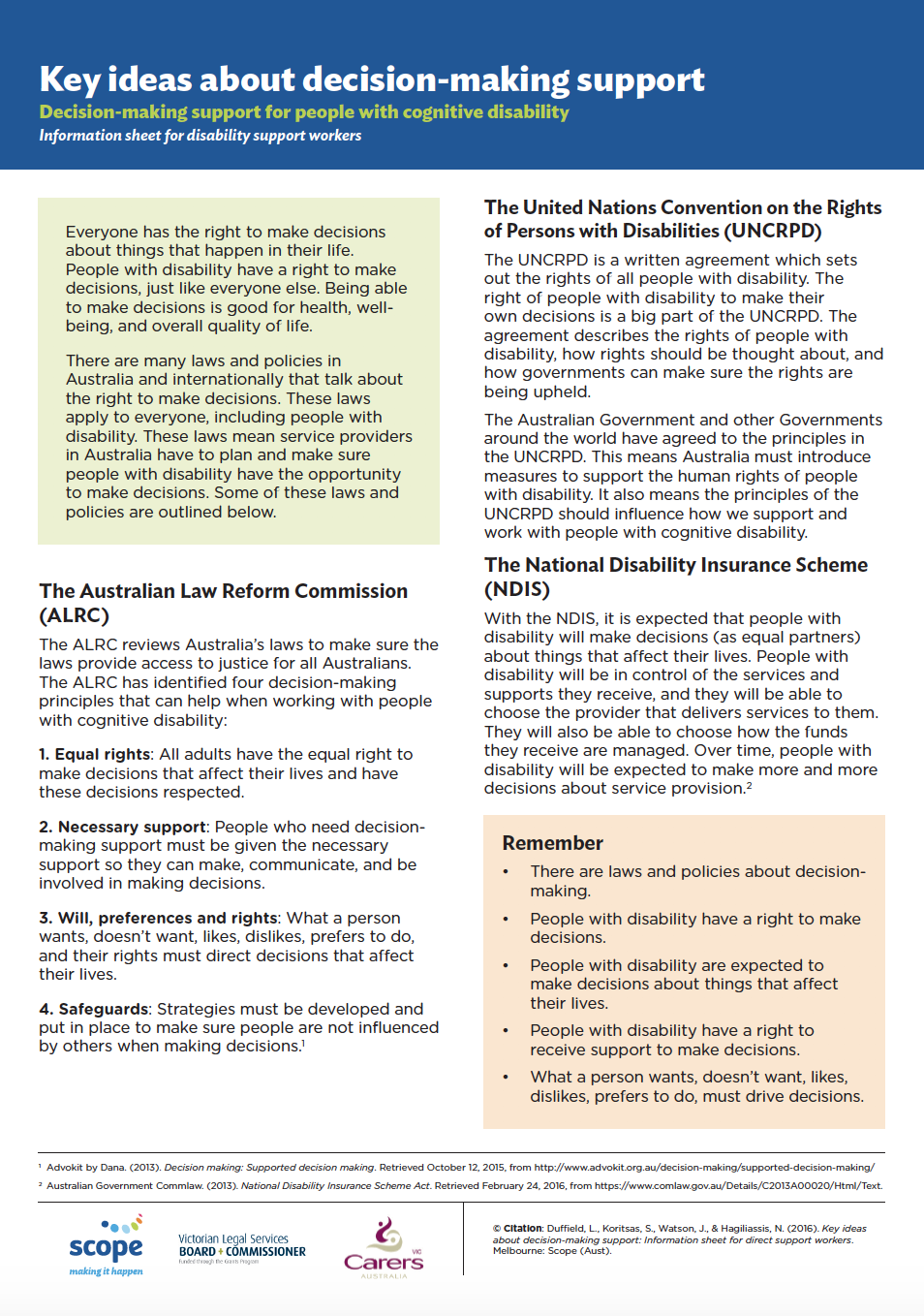
Introduction to Decision-Making Support
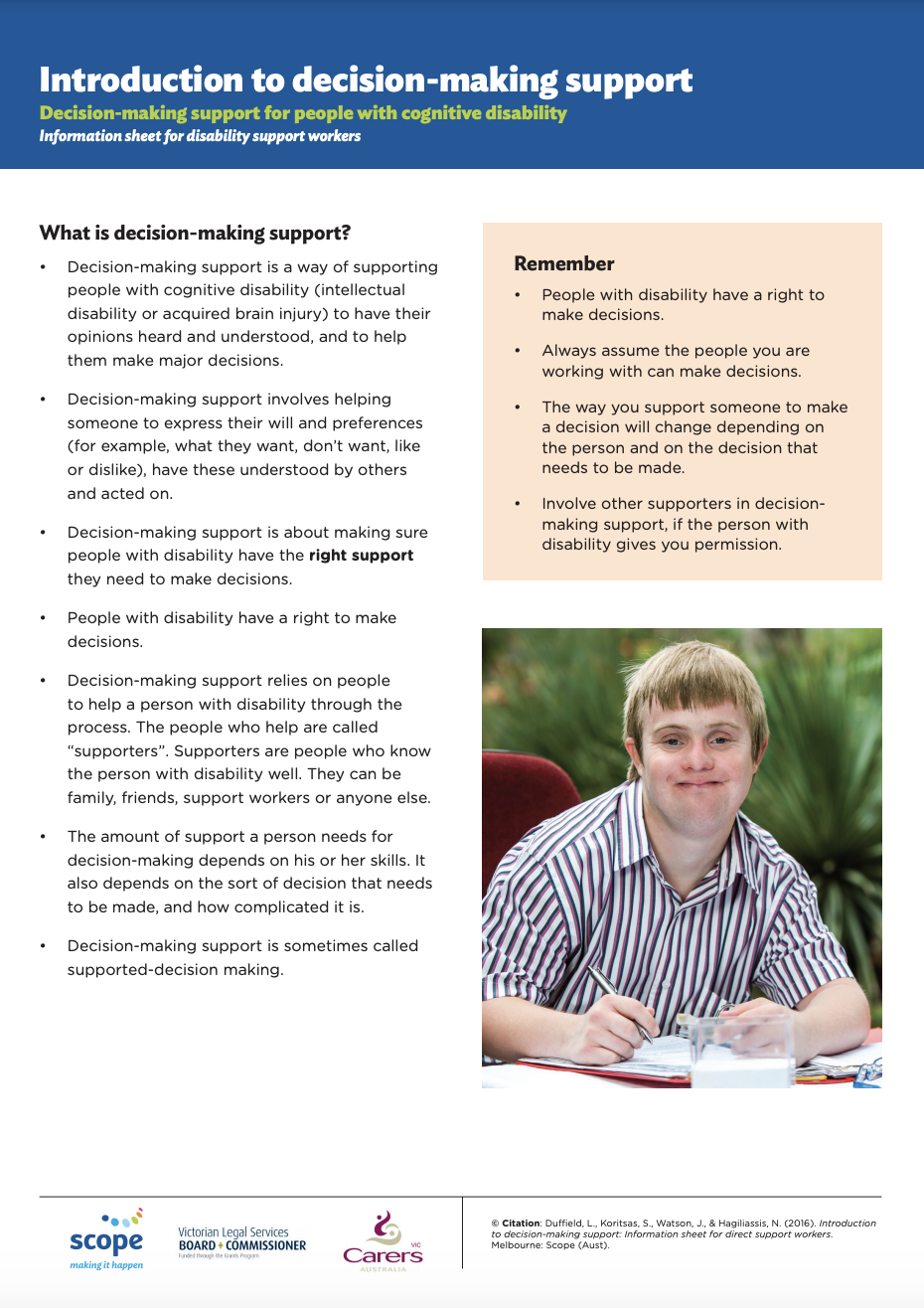
This is a factsheet designed for support workers about decision-making support. Decision-making support is a way of supporting people with cognitive disability (intellectual disability or acquired brain injury) to have their opinions heard and understood, and to help them make major decisions.
Decision Making Support for People with Cognitive Disability
This booklet sets out guidelines for disability workers to help people with cognitive disability make decisions.
Dealing with Challenges in Providing Decision-Making Support
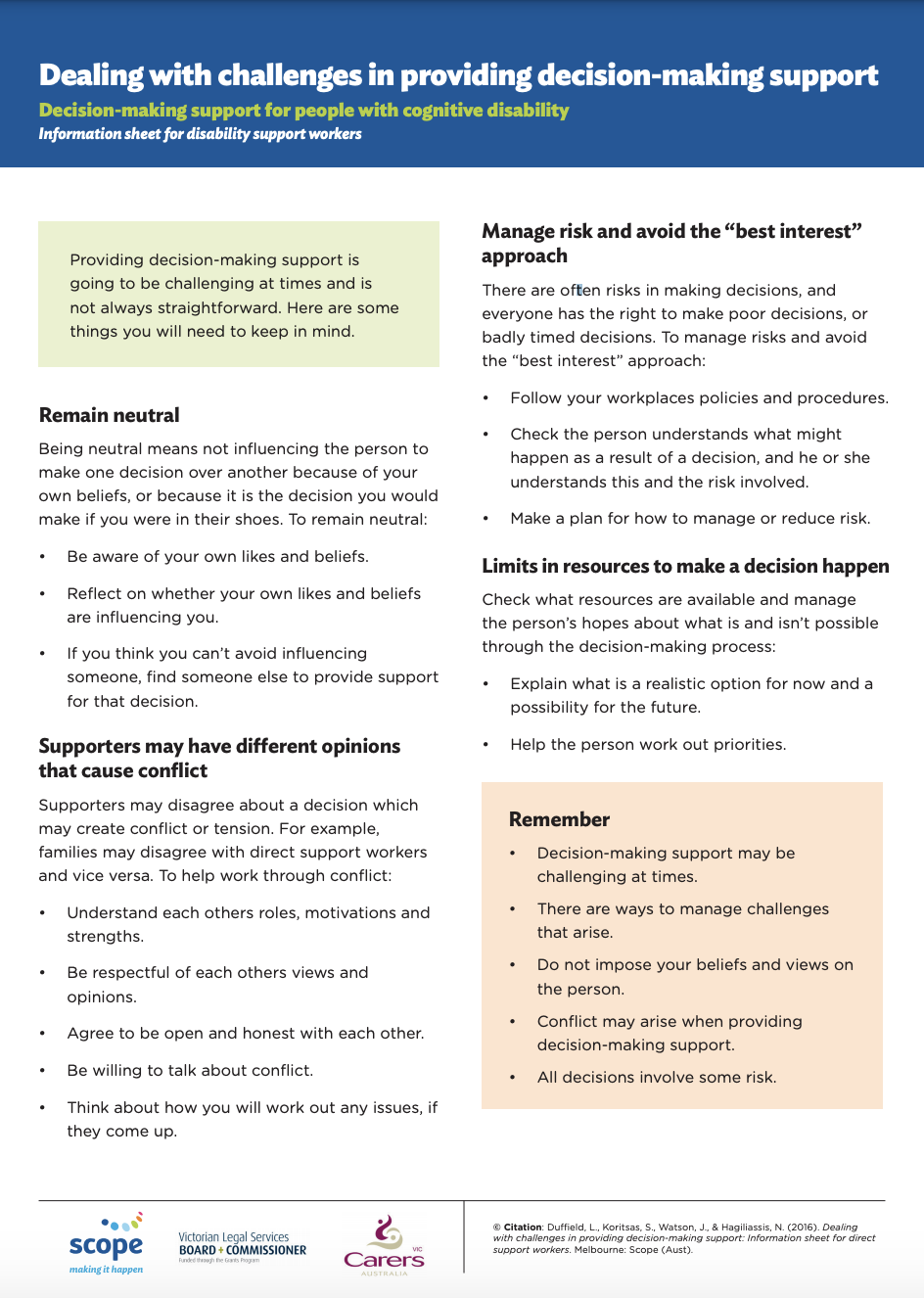
Providing decision-making support is going to be challenging at times and is not always straightforward. Here are some things you will need to keep in mind.
The Role of Supporters
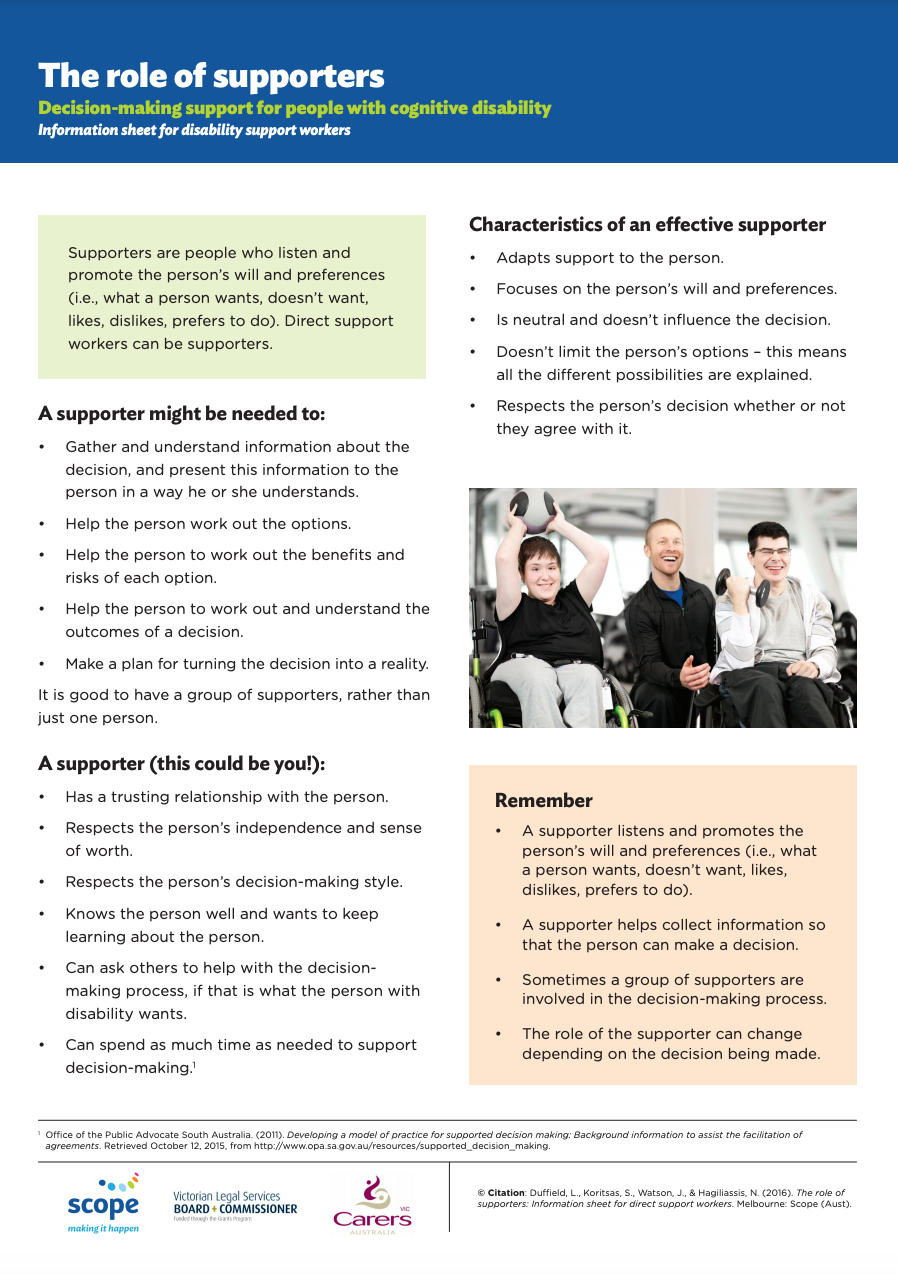
This is a factsheet about the role of supporters of people with disability. Supporters are people who listen and promote the person’s will and preferences (i.e., what a person wants, doesn’t want, likes, dislikes, prefers to do).
Easy Read Photo Consent Form
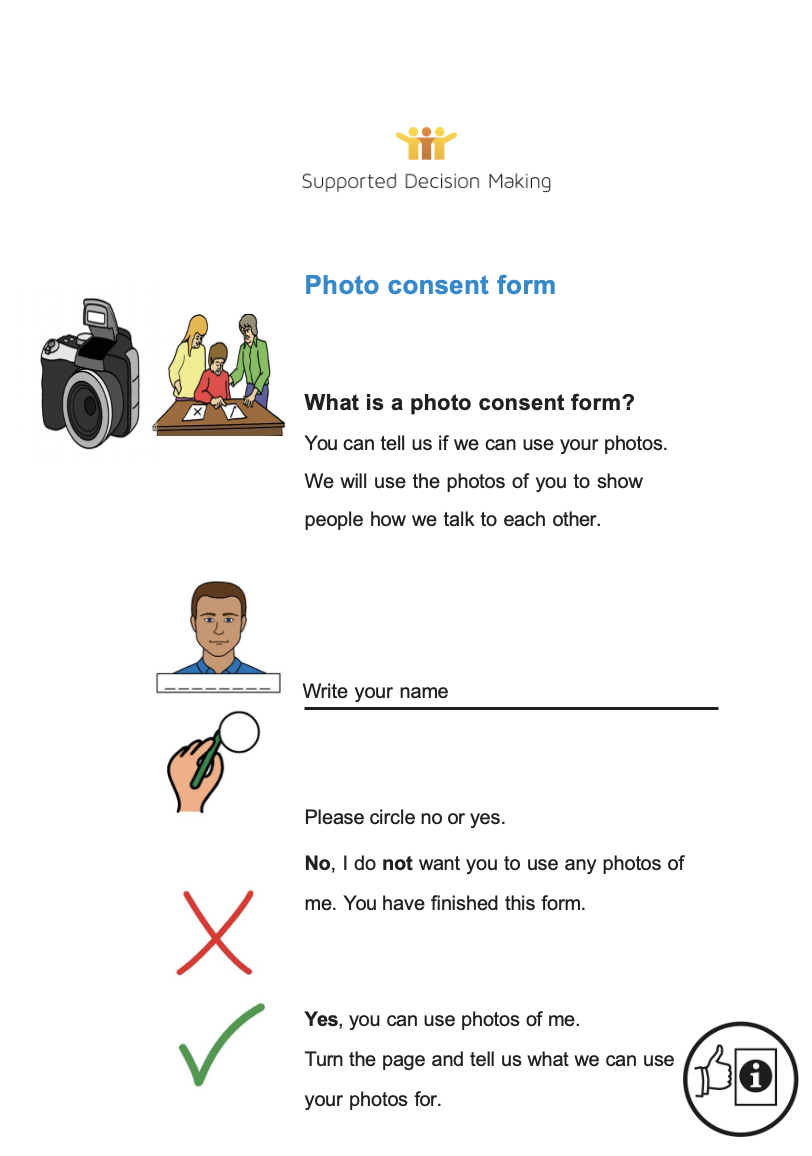
An example of an easy read consent form, for the use of photos of people.
Easy Read Consent Form
This is an easy read consent form for the use of photos and videos of people.
Supported Decision Making: Understanding How its Conceptual Link to Legal Capacity is Influencing the Development of Practice
This article aims to help readers to understand the conceptual link between supported decision making and legal capacity and how this is influencing the development of practice. It examines how the concept has been defined as: a process of supporting a person with decision making; a system that affords legal status; and a means of bringing a person’s will and preference to the centre of any substituted decision-making process.
The conceptual link between supported decision making and legal capacity is explored by outlining three conceptualisations that are influencing the development of practice. It is important to understand the difference between supported decision making and support with decision making. Both involve offering support to a person who is unable to navigate decision making independently. However, the key difference is whether or not the process results in greater legal capacity for the individual. Additionally, supported decision making requires the development of legal mechanisms that legitimise the interdependent nature of decision making and the concept of shared capacity.
By having a greater understanding of the conceptual foundations of supported decision making, practitioners can engage in more focused evaluation of proposed new law reform and practice. Research will be vital in understanding how supported and substituted decision making could coexist and how mental capacity could be assessed in this new decision making paradigm. If a more substantial theory of practice can be developed, supported decision making has the potential to empower and enrich the lives of people with cognitive disabilities, both in Australia and all over the world.
Future Directions in Supported Decision-Making
This article explores the theoretical foundations of supported decision-making and the evolution of supported decision-making research. It explains the research that is emerging in leading jurisdictions, the United States and Australia, and its potential to transform disability services and laws related to decision-making. Finally, it identifies areas of concern in the direction of such research and provides recommendations for ensuring that supported decision-making remains protective of the rights, will and preferences of people with cognitive disability.
Social researchers and participants with intellectual disabilities and complex communication access needs: Whose capacity? Whose competence?
Despite the evolution of inclusive research and augmentative and alternative communication, there is an ongoing absence of people with intellectual disabilities and complex communication (access) needs from sociological cohorts. In an in-depth study of 10 individuals with complex communication access needs, the involvement of three participants with intellectual disabilities was highlighted. The purpose of this article is to describe how the investigation was conceptualised, designed, and adapted to maximise the participation of adults with intellectual disabilities and complex communication access needs. Revealed are the adaptations and approaches made to the core elements of the study: communication access, research design, consent-to-research, and methods. Also described are subsequent participant insights on the topic of inclusion of people with complex communication access needs in research. The investigation contributes to an evolving body of literature on inclusive research, highlighting tensions of competence and capacity, as well as capacity-building challenges more broadly.
Supporting Nick to make decisions: A personal exploration of choice
Every voice counts: Exploring Communication Accessible Research Methods
Despite a proliferation of qualitative research methods and the advancement of augmentative and alternative communication (AAC), people with Complex Communication (Access) Needs (CCAN) are often absent from sociological study cohorts. Proxy interviewing is common but it leaves viewpoints to be shaped by others. Herein the purpose of the study was to develop and test new methods of data collection that would improve access to research participation for people with CCAN. This article reports on the development, implementation and evaluation findings of four data collection techniques. These methods, ‘theory generated photo elicitation’ ‘adapted image selection’ ‘participant sensory selection’ and ‘sensory ethnography’ were tested and implemented in a study of people with CCAN. The study contributes to the knowledge of communication accessible research participation with applicable to disability-based qualitative research across multiple fields.
Delivering decision making support to people with cognitive disability — What has been learned from pilot programs in Australia from 2010 to 2015
The UNCRPD has generated debate about supported decision making as a way to better enable people with cognitive disability to participate in decision making. In Australia, between 2010–2015, a series of projects have piloted various models of delivering decision making support. A critical review was conducted on the program documents and evaluations of these pilot projects. The pilots were small scale, conducted by both statutory and non-statutory bodies, and adopted similar designs centred on supporting a decision maker/supporter dyad. Primarily, participants were people with mild intellectual disability. Themes included: positive outcomes; uncertain boundaries of decision support; difficulty securing supporters; positive value of program staff and support to supporters; limited experience and low expectations; and varying value of written resources. The lack of depth and rigour of evaluations mean firm conclusions cannot be reached about program logics, costs or outcomes of the pilots. The pilots demonstrate feasibility of providing support for decision making rather than resolving issues involved in delivering support. They suggest that some form of authority may facilitate the role of decision supporters, help to engage others in a person’s life, and integrate decision making support across all life domains
Supported Decision-Making for People with Cognitive Impairments: An Australian Perspective?
Honouring the requirement of the Convention on the Rights of Persons with Disabilities to introduce supported decision-making poses many challenges. Not least of those challenges is in writing laws and devising policies which facilitate access to formal and informal supports for large numbers of citizens requiring assistance with day-to-day issues such as dealing with welfare agencies, managing income security payments, or making health care decisions. Old measures such as representative payee schemes or “nominee” arrangements are not compatible with the CRPD. However, as comparatively routine social security or other government services become increasingly complex to navigate, and as self-managed or personalised budgets better recognise self-agency, any “off the shelf” measures become more difficult to craft and difficult to resource. This paper focuses on recent endeavours of the Australian Law Reform Commission and other local and overseas law reform and policy initiatives to tackle challenges posed both for ordinary citizens and those covered by special programs (such as Australia’s National Disability Insurance Scheme and “disability trusts” in Australia and Canada).
Assumptions of Decision-Making Capacity: The Role Supporter Attitudes Play in the Realisation of Article 12 for People with Severe or Profound Intellectual Disability
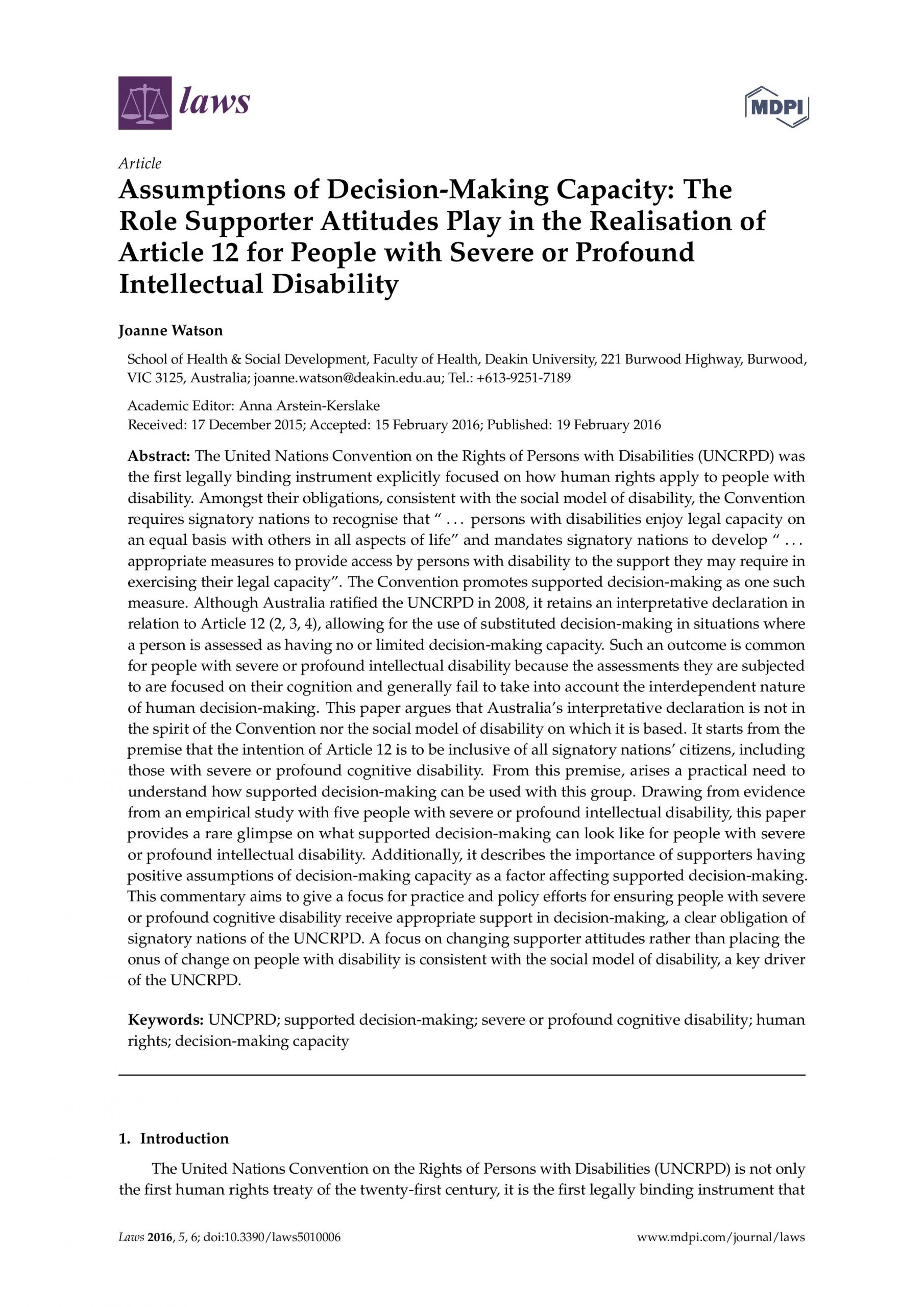
The United Nations Convention on the Rights of Persons with Disabilities (UNCRPD) was the first legally binding instrument explicitly focused on how human rights apply to people with disability. Amongst their obligations, consistent with the social model of disability, the Convention requires signatory nations to recognise that “… persons with disabilities enjoy legal capacity on an equal basis with others in all aspects of life” and mandates signatory nations to develop “ . . . appropriate measures to provide access by persons with disability to the support they may require in exercising their legal capacity”. The Convention promotes supported decision-making as one such measure. Although Australia ratified the UNCRPD in 2008, it retains an interpretative declaration in relation to Article 12 (2, 3, 4), allowing for the use of substituted decision-making in situations where a person is assessed as having no or limited decision-making capacity. Such an outcome is common for people with severe or profound intellectual disability because the assessments they are subjected to are focused on their cognition and generally fail to take into account the interdependent nature of human decision-making. This paper argues that Australia’s interpretative declaration is not in the spirit of the Convention nor the social model of disability on which it is based. It starts from the premise that the intention of Article 12 is to be inclusive of all signatory nations’ citizens, including those with severe or profound cognitive disability. From this premise, arises a practical need to understand how supported decision-making can be used with this group. Drawing from evidence from an empirical study with five people with severe or profound intellectual disability, this paper provides a rare glimpse on what supported decision-making can look like for people with severe or profound intellectual disability. Additionally, it describes the importance of supporters having positive assumptions of decision-making capacity as a factor affecting supported decision-making. This commentary aims to give a focus for practice and policy efforts for ensuring people with severe or profound cognitive disability receive appropriate support in decision-making, a clear obligation of signatory nations of the UNCRPD. A focus on changing supporter attitudes rather than placing the onus of change on p
Developing an Understanding of Supported Decision-Making Practice in Canada: The Experiences of People with Intellectual Disabilities and Their Supporters
Placing The Preferences Of People With Profound Intellectual And Multiple Disabilities At The Centre Of End Of Life Decision Making Through Storytelling
From Provisions to Practice: Implementing The Convention
With supported decision-making, the presumption is always in favour of the person with a disability who will be affected by the decision. The individual is the decision maker; the support person(s) explain(s) the issues, when necessary, and interpret(s) the signs and preferences of the individual. Even when an individual with a disability requires totalsupport, the support person(s) should enable the individual to exercise his/her legal capacity to the greatest extent possible, according to the wishes of the individual. This distinguishes supported decision-making from substituted decision-making, such as advance directives and legal mentors/friends, where the guardian or tutor has court-authorized power to make decisions on behalf of the individual without necessarily having to demonstrate that those decisions are in the individual’s best interest or according to Development and human rights for all.